10 Things No One Tells You About Identity Shifts After 50

If you’re feeling unsettled lately, not necessarily unhappy or in a crisis, just quietly unsure (and even confused) of who you are becoming, let me tell you that you’re not imagining it.
- If parts of your life still work, but you don’t quite fit inside them anymore.
- If you feel yourself pulling back from roles, expectations, or identities that once felt natural.
This isn’t necessarily a problem to fix; it may be that you’re experiencing an identity shift after 50.
These changes rarely announce themselves.
Here are ten things no one tells you about identity shifts after 50.
1. It Starts As Discomfort, Not Clarity
Unfortunately, identity shifts don’t arrive with answers; they arrive as unease.
You can feel a subtle irritation, an unexplained heaviness, or a sense that you’re performing a version of yourself that once fit – but no longer does.
In my case, it showed up as tiredness that rest didn’t fix.
Not physical tiredness, but emotional friction.
2. Nothing Is “Wrong” – And That Makes It Harder
One of the most confusing parts is that nothing is obviously broken.
- Your relationships may be stable.
- Your routines are functional.
- Your life is respectable.
Which makes the internal shift easy to dismiss.
I spent a long time telling myself I should be grateful, and I was. But gratitude didn’t stop how I was feeling deep inside.
3. You Grieve Versions Of Yourself You Thought Were Final
No one talks about the quiet grief.
- The mother whose identity was formed in the doing, caring, and showing up, and who now has to meet herself outside of that role.
- The letting go of the woman who pushed through.
- The one who knew how to cope.
- The one who could override herself and keep going.
I didn’t expect to miss those versions of me.
But I did.
They’d carried me a long way, mostly on autopilot.
4. Your Tolerance Drops – For Everything
What once felt manageable suddenly feels noisy.
- People-pleasing.
- Overcommitting.
- Making yourself smaller to keep things smooth.
Your nervous system is no longer interested in endurance as a lifestyle. And when tolerance drops, it’s not weakness, it’s information.
This is often when women say, “I don’t know what’s wrong with me lately.”
5. You Stop Wanting To Explain Yourself
Earlier in life, identity changes often come with announcements:
- A new job title
- A move
- A relationship status update
- Becoming a mother
There always seemed to be a clear reason you could point to and explain. There’s language for it and a storyline others could recognise.
But at this midlife stage? Silence.
I noticed I didn’t want to justify my choices anymore.
I didn’t need nor want permission. I didn’t want to debate or reassure anyone that what I was doing made sense.
You stop needing other people to understand your choices, even before you fully understand them yourself.
6. Old Labels No Longer Fit – Even The Positive Ones
Do you recognise any of these?
- Capable
- Reliable
- Strong
- The one who holds it all together
These labels once felt affirming; then they started to feel heavy.
At some point, I realised I didn’t want to be known for coping or being strong anymore.
All I want now is to feel like myself while living my own life.
The way I want to live it.
7. You Become More Honest About What Costs You
You start noticing the price of things you once accepted without question.
- Conversations that drain you.
- Obligations that leave you flat.
- Roles that require constant self-abandonment.
This isn’t you becoming selfish; it’s awareness that you don’t want to keep paying the same emotional price.
“What does this cost me – really?“
8. You Need More Space Than You Can Explain
I don’t necessarily mean space to ‘figure everything out.’
Just space:
- To think less.
- To feel more.
- Not to be needed all the time.
I didn’t want answers. I wanted room to breathe without being shaped by expectation.
9. You Don’t Want A New Life – You Want A Truer One
This is where identity shifts are often misunderstood.
You’re not trying to reinvent yourself from scratch, and you’re not chasing a fantasy version of life.
Instead:
- You’re shedding what’s false.
- Softening what’s forced.
- Returning to something quieter and more honest.
10. The Shift Is Slower Than You Expect – And Deeper Than You Imagine
What I’ve found is there’s no dramatic ‘after’ moment.
- Just small choices.
- Gentler boundaries.
- Different reactions.
- A growing sense of internal steadiness.
Looking back, I can see that who I am now formed gradually, through small daily choices where I no longer put myself last.
This kind of change doesn’t announce itself; it integrates.
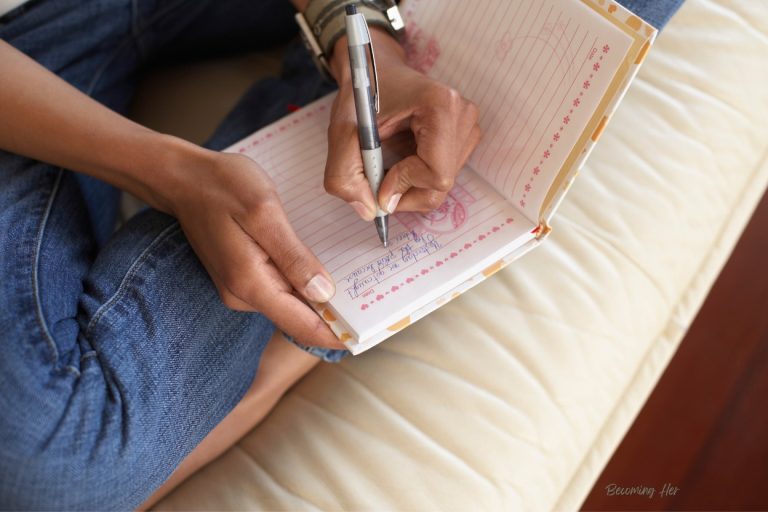
Not journaling to necessarily ‘figure myself out’, but to notice patterns. To hear my own voice without interruption and to let the quieter truths surface without needing to act on them immediately.
That’s why I created Becoming Her: The 30-Day Midlife Identity Shift Journal. It isn’t about reinvention or goals. It’s about creating a safe place to sit with who you’re becoming, one question at a time, without rushing the answer.
In Closing
If you’re in the middle of an identity shift after 50, the uncertainty you’re feeling is a natural response to real internal change.
You’re responding honestly to who you are now.
And that kind of truth doesn’t need urgency.
- It needs patience.
- It needs safety.
- It needs time.
Sometimes the bravest thing you can do is let yourself change without forcing the outcome.

Claire writes about midlife identity, where she shares her reflections on reinvention, mindset, and creating gentle income without burnout.
After 30 years of starting over in different ways, she now writes for women 50+ who feel called to live more intentionally, trust themselves again, and build a quieter kind of freedom.
She is the creator of the Becoming Her Journal, a reflective guide for identity shifts in midlife.